
 Tiếng Việt
NOx exhaust treatment
If you need a NOx emissions treatment unit, please contact us for a free survey and consultation.
To learn more about NOx emissions treatment, read the following article carefully.
097 222 1608

If you need a NOx emissions treatment unit, please contact us for a free survey and consultation.
To learn more about NOx emissions treatment, read the following article carefully.
097 222 1608
Man-made sources of NOx emissions
Hasy Environment is a consulting unit, providing exhaust gas treatment systems with many years of experience in the field of exhaust gas treatment
We are confident in meeting the strict requirements given by our customers. Aiming to jointly build and develop sustainable, environmentally friendly sesame production
Expenditures set for a project by Hasy Environment
The use of catalytic converters in automobiles makes plans to control mobile NOx emissions very limited.
As a result, stationary sources of NOx emissions are now subject to more stringent standards. Includes plants that produce nitric acid, nitrate materials such as fertilizers, and explosives. Industrial production (metallurgical plants, glass manufacturing, cement kilns, generators, etc.) where high processing temperatures are used.
NOx is the main pollutant substance in the atmosphere, and is agents of acid rain, photochemical smog and ozone accumulation.
The main oxides are nitrogen monoxide (NO) and nitrogen dioxide (NO2) both of which are corrosive and dangerous to health.
At high temperatures, oxygen and nitrogen present in the air combine to form nitrogen oxides. Typical exhaust samples contain 100-1500 ppm NOx.
The unrecoverable exhaust gas in the final absorber typically contains 2-3% NOx based on the weight of acid produced.
Many processes in which nitric acid, nitrate or nitrite are used as reagents result in the generation of NOx emissions. For example, manufacturing explosives, plastics, dyes, etc
Processes in which materials are manufactured at high temperatures such as glass manufacturing, electric furnaces and cement kilns generate NOx emissions.
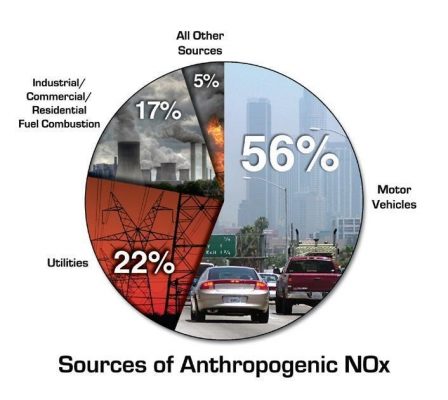
Man-made sources of NOx emissions
Volcanic activity spews out huge amounts of pollutants including NOx (mainly N2O2, NO)
Due to natural causes as well as unconscious human activities, pollutants such as smoke, dust, SOx, NOx, CO…
Due to the fermentation process of organic matter in landfills, swamps, animal carcasses, etc.

Natural sources of NOx emissions
Bysupplying NH3 gas into the high-temperature exhaust gas stream. NO is selectively reduced to N2 without a catalyst.
The reaction takes place very quickly at temperatures above 9000C. Maximum NOx removal efficiency is achieved at temperatures around 10000C. The greater the amount of NH3 introduced, the higher the treatment efficiency.
Below is the simple equation of the reaction using NH3:
4NO + 4 NH3 + O2 → 4 N2 + 6 H2O
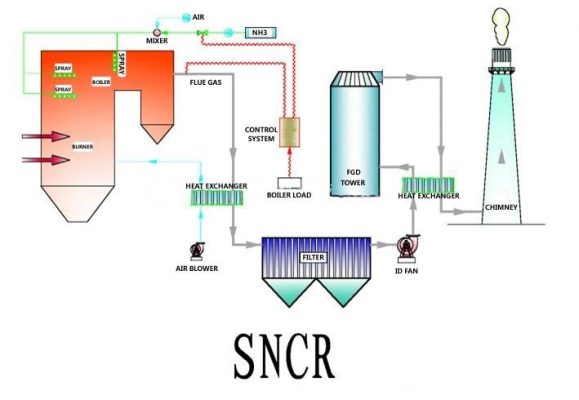
If the amount of NH3 added increases, the treatment efficiency can be higher, but at the same time, the amount of unreacted NH3 also increases to form NH4 HSO4.
This problem appears in the case of catalytic NOx reduction with NH3. For boilers, the retention time at different NOx treatment temperature ranges is very short, the treatment efficiency reaches 30 – 50%.
Using urea (CO(NH2)2) as a reducing agent has been put into practical use. The reaction is as follows:
CO(NH2)2 + 2NO + 1/2O2 → 2N2 + 2H2O + CO2
The urea solution is sprayed in mist form into the furnace. The investment and operating costs of this method are the lowest. Treatment with urea solution is simple and safe.

NH3 is a reducing agent capable of selectively reacting with NO and NO2 at temperatures higher than 2320C. The reduction process is carried out on the catalytic surface to form nitrogen and water according to the following reactions:
4NO + 4NH3 + O2 → 4N2 + 6H2O
2NO2 + 4NH3 + O2 → 3N2 + 6H2O
6NO + 4NH3 → 5N2 + 6H2O
6NO2 + 8NH3 → 7N2 + 12H2O
Some catalytic groups commonly used in this process include:
Recently, because NH3 is a chemical with a strong and unpleasant odor, urea solution is used to replace it.
In addition, people also use a number of other methods to treat NOx such as: adsorbing NOx with silicagel, alumogel, activated carbon…
Why choose?