
 Tiếng Việt
Printing ink wastewater treatment
If you need a printing ink wastewater treatment unit, please contact us for a free survey and consultation.
To learn more about printing ink wastewater treatment, read the following article carefully.
097 222 1608

If you need a printing ink wastewater treatment unit, please contact us for a free survey and consultation.
To learn more about printing ink wastewater treatment, read the following article carefully.
097 222 1608
Images of different ink colors
Hasy Environment is a consulting unit, providing wastewater treatment systems with many years of experience in the field of wastewater treatment.
We are confident in meeting the strict requirements given by our customers. Aiming to jointly build and develop sustainable, environmentally friendly sesame production
Expenditures set for a project by Hasy Environment
Society is increasingly developing, consumer tastes are increasingly improving. That’s why the printing and ink production industries have also developed outstandingly in both quantity and quality to meet the needs of the market.
However, during the production process, large amounts of wastewater with high concentrations of pollution are created, affecting the environment and human health. Therefore, building a printing ink wastewater treatment system before being discharged into the environment is very necessary.
To create products with diverse colors for the ink industry, behind those colorful products, many production steps are needed. Depending on the type of product, the production process may be different, but the basic process is Ink production is carried out in the following lines:

Printing ink production process diagram
Throughthe printing ink production line, we can see that there is not much wastewater during the production process. Mainly arising from the process of cleaning equipment and factories.
Printing ink wastewater is not much, but the concentration of pollutants is very high: organic matter from pigments; high color intensity; total nitrogen, phosphorus; floating solids.

Printing ink wastewater quality parameter table
Due to the characteristics ofprinting ink wastewater with the ratio BOD/COD < 1/2, so we cannot use only the microbiological method. In addition, with the investment cost being too high if only using physicochemical methods, we – Hasy Environment offer a solution that combines the use of physicochemical and microbiological methods to achieve both effective and economical treatment. High.
Below is the processing technology line:
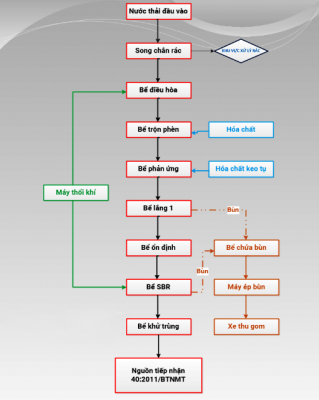
Printing ink wastewater treatment line diagram
Production wastewater is led directly to the production system through the trash screen.
The trash screen is responsible for removing large substances to avoid clogging pipes and affecting the equipment and systems behind. Garbage will be periodically collected and transported to processing sites.
This is a place that helps stabilize the concentration and flow of waste streams. An aeration system is arranged here to create disturbance to avoid sedimentation and anaerobic decomposition in the tank. At the same time, arrange a submersible pump to pump wastewater from the conditioning tank into the physical and chemical treatment system behind.
The reaction neutralizes the charge of particles in wastewater when combined with alum. The alum mixing tank is installed with a stirring device to create turbulent flow. This helps the amount of alum to mix evenly into the wastewater. At the same time, it helps the reaction time to occur faster.
This is where the flocculation and flocculation process takes place. Under the effect of added flocculation aids, colloidal particles bond together to form flocs of larger size and volume, creating favorable conditions for the sedimentation process to take place in the physicochemical sedimentation tank. than.
The mixture of water and flocs from the flocculation tank flows to the sedimentation tank. Under the effect of gravity, the flocs will fall to the bottom of the tank, while the water goes out. The sludge at the bottom of the settling tank will be periodically collected and pumped to the sludge tank.
This is a place to keep wastewater with a suitable environment for treatment microorganisms to grow by adjusting pH value, water flow, and nutritional factors for microorganisms.
Here, aerobic biological treatment occurs under the influence of aerobic microorganisms. The tank operates in three processes: Filling – reactive aeration (accounting for 50% of the entire process time), settling without aeration (25% of the process time) and draining (25% of the process time). progress). At the end of the process, the water will be led out into the disinfection tank, a part of the excess sludge will also be discharged into the sludge tank. For details on SBR technology, please refer to the articlewastewater treatment using SBR Technology.
Water after biological treatment will flow into the disinfection tank. Here, the wastewater is exposed to the disinfectant chemical Chlorime at the appropriate dose in a zigzag flow to facilitate contact between the wastewater and the disinfectant chemical with the purpose of killing microorganisms, bacteria, and fungi. virus.
Treated wastewater ensures to meet type B discharge standards according to QCVN 14:2008/BTNMT.
Hasy Environment has many years of experience designing and constructing domestic wastewater treatment systems for businesses. We are always proud to bring our customers a quality product.
Why choose?