
 Tiếng Việt
Sugarcane wastewater treatment
If you are in need of a sugarcane wastewater treatment unit, please contact us for a free survey and consultation.
To learn more about sugarcane wastewater treatment, read the following article carefully.
097 222 1608

If you are in need of a sugarcane wastewater treatment unit, please contact us for a free survey and consultation.
To learn more about sugarcane wastewater treatment, read the following article carefully.
097 222 1608
Image of sugarcane raw materials supplied to the sugar industry
HASY Environment is a consulting unit, providing wastewater treatment systems with many years of experience in the field of treatment wastewater treatment
We are confident in meeting the strict requirements given by our customers. Aiming to jointly build and develop sustainable, environmentally friendly production
Expenditures set for a project of HASY Environment
Our country has a tropical monsoon climate that is very favorable for the development of the sugar industry. Sugarcane output is increasing to meet consumer demand. However, besides the benefits that contribute to the economy, the environmental issues of this industry also deserve attention, including the problem of sugar factory wastewater treatment.
To produce raw sugar and refined sugar, many different processing steps and different ingredients are needed. Sugarcane production generates extremely large amounts of wastewater at many stages of production with varying concentrations of pollution. Wastewater mainly arises from the following sources:
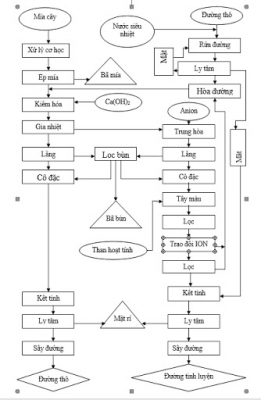
Drawing process diagram for raw and refined sugar processing
Sugar cane wastewater has very high levels of organic matter, nitrogen, phosphorus, and residue. In addition, wastewater also contains many ingredients from additives and detergents. Below is a table of pollution parameters of sugarcane wastewater:
 Parameter table of pollution indicators in sugarcane wastewater
During the cooling of machinery and equipment, as well as other processes, the discharged water source has a high temperature. Then glucose and fructose will be converted into large molecules that are very stable and difficult to penetrate microbial membranes. Because the most appropriate technology to treat sugarcane wastewater is to use combined aerobic and anaerobic digestion em>. Anaerobic microorganisms will decompose organic substances into smaller and easily decomposable organic substances. These easily decomposable organic substances will be processed in the aerobic biological tank. Below is a typical technology applied to sugarcane wastewater treatment:
 p>
Diagram of sugarcane wastewater treatment technology line
Collected wastewater passes through screens to remove large-sized coarse impurities to avoid clogging the works and equipment behind.
Sugar cane wastewater contains a lot of soil and sand from the process of washing raw materials, these substances will be retained in the sand settling tank. Sand in the settling tank will be transferred to the sand drying yard.
After passing through the sand settling tank, wastewater is concentrated and transferred to the collection pit. This is where wastewater is collected to be transferred to the downstream treatment system.
Wastewater from the collection pit will be transferred to the equalization tank. The regulation tank has the function of stabilizing the concentration and flow of wastewater. An air blower is installed here to avoid anaerobic decomposition that occurs when suspended substances settle to the bottom of the tank.
Wastewater from the equalization tank is pumped to settling tank 1. Part of the suspended solids will be removed here to reduce the treatment volume behind, while creating favorable conditions for the biological treatment process.
This is a reverse flow anaerobic biological tank. In the UASB tank, anaerobic decomposition occurs under the influence of anaerobic microorganisms in the absence of oxygen.
The anaerobic treatment process in the tank is divided into four stages: Hydrolysis of polymers, fermentation of amino acids and sugars (Acidification), anaerobic digestion (Aceticization) and formation of methane gas (Methanization) .
Wastewater after treatment at the UASB tank will be transferred to the Aerotank tank. At the Aerotank. Active aerobic microorganisms help decompose remaining organic matter.
Helps settle residue from biological processes and clarify water. Part of the sludge is circulated to the Aerotank, the rest is discharged to the sludge tank.
The task of the pressure filter is to remove small residues, residual odors, and colors before transferring to the disinfection tank.
Wastewater is disinfected with chlorine solution in a zigzag flow to eliminate disease-causing bacteria and viruses.
Sugar cane wastewater after treatment reaching column A, QCVN 40:2025/BTNMT (replacing QCVN 40:2011/BTNMT under the transition roadmap) will be discharged to the receiving source.

With many years of experience and a team of high-level officials and engineers in the field of design and construction of wastewater treatment systems. Hasy environment has brought customers quality products, creating reputation with many domestic and foreign factories. If you need advice or support, please contact our technical staff immediately.
Why choose?