
 Tiếng Việt
LABORATORY EXHAUST GAS TREATMENT
If you need a laboratory exhaust treatment unit, please contact us for a free survey and consultation.
To learn more about laboratory waste treatment, read the following article carefully.
097 222 1608

If you need a laboratory exhaust treatment unit, please contact us for a free survey and consultation.
To learn more about laboratory waste treatment, read the following article carefully.
097 222 1608
Laboratory exhaust gas treatment system
Hasy Environment is a consulting unit, providing exhaust gas treatment systems with many years of experience in the field of exhaust gas treatment
We are confident in meeting the strict requirements given by our customers. Aiming to jointly build and develop sustainable, environmentally friendly sesame production
Expenditures set for a project of Hasy Environment
Laboratories today have become popular and play an extremely important role. More and more products require controlled, testing conditions that only laboratories can provide.
The chemicals used in laboratories are very volatile when carrying out chemical reactions , preparing solutions, handling analytical samples, rinsing instruments and preserving and storing chemicals.
Therefore, installing a laboratory exhaust gas treatment system is extremely necessary.
Previous environmental monitoring results at several laboratories showed laboratory emissions can be classified into 2 types as follows:

Illustration of laboratory exhaust
Many organic compounds are volatile and inorganic compounds are quite toxic to the nervous system.
Even at low concentrations, it makespeople dizzy, headache, chest tightness, nausea, intoxication faintingeven causes loss of motor function. Methanol, butanol, phenol… are all capable of causing poisoning .
Some solvents and reagents can cause anesthesia such as ethers, chloroform, carbon tetrachloride. Damages the mucous membranes of the nose, throat, and eye mucous membranes such as n-butylaxetate ester, crotonic aldehyde.
In particular, aromatic compounds such as benzene, pyridine, toluene… can cause serious diseases such as cancer.
With its complex and dangerous characteristics, installing the system is difficult. Exhaust gas managementarising from fume hoods and gas-generating equipment in the laboratory must ensure that exhaust gases do not escape into the environment inside the laboratory and do not affect the surrounding area
Contaminated gases will be captured by the laboratory fume hood. It is then transported through pipes to the gas treatment equipment installed outside. To exhaust gas treatment must undergo through two separate stages: absorption and adsorption
At absorption tower, the solution Dilute alkaline has a disinfecting effect and will thoroughly absorb acid vapors and a portion of organic solvents in laboratory emissions.
The absorption solution is stored in a tank and pumped into the absorption tower. The water in the tank is replenished and chemicals are added regularly through the chemical pump system. Wastewater is periodically drained and cleaned and collected into the wastewater treatment system.
The adsorption tower containsactivated carbon for the purpose of removing volatile organic solvents and bad odors in laboratory emissions .
In the adsorption tower, activated carbon is calculated and used with appropriate type, quantity and arrangement /strong> to increase processing efficiency. Activated carbon is used and periodically replaced. The amount of coal discharged from the system is managed as solid waste according to current regulations.
Gas after leaving the adsorbent meets the standards according to QCVN 05: 2013/BTNMT, QCVN 06: 2009/BTNMT and QCVN 20:2009/BTNMT, will be discharged directly into the environment.
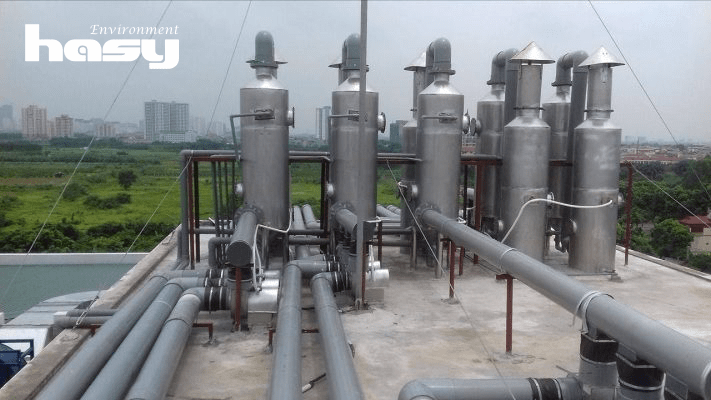
Laboratory processing system
Why choose?