
 Tiếng Việt
CEMENT FACTORY EXHAUST GAS TREATMENT
If you need a cement factory exhaust gas treatment unit, please contact us for a free survey and consultation.
To learn more about cement waste treatment, read the following article carefully.
097 222 1608

If you need a cement factory exhaust gas treatment unit, please contact us for a free survey and consultation.
To learn more about cement waste treatment, read the following article carefully.
097 222 1608
Cement production process
Hasy Environment is a consulting unit, providing exhaust gas treatment systems with many years of experience in the field of exhaust gas treatment
We are confident in meeting the strict requirements given by our customers. Aiming to jointly build and develop sustainable, environmentally friendly sesame production
Expenditures set for a project of Hasy Environment
Vietnam is a developing country, with a high migration rate to big cities. Therefore, besides steel production and electricity production, cement production is the most important industry in Vietnam.
Along with economic and social growth, the demand for cement in the construction industries has also increased sharply. Therefore, Vietnam is facing seriously degraded air quality.
Therefore, it is necessary to have emergency measuresto treat and control emissions from cement factories. To ensure human health and minimize climate change.
The main air pollutants from cement factory emissions are dust, CH4, VOCs, NOx, SOx, CO and CO2..
It is the cause of global warming, and also a factor harmful to human health. It has adverse effects on air, water and soil.
Decreased growth rate of plants due to pollutants released into the environment. It also changes thechemical composition of the soil. Pollutants settle into water, harming aquatic life. For humans, it causes respiratory diseases, eye and skin irritation, etc. Long-term exposure can be a factor in causing cancer.
Cement production process
Exhaust gases in cement factories include two main components: dust and pollutants. strong>
They arise in the production process from raw material extraction to finished product packaging. There are also emissions from transportation and fuel used.
CO2 is produced during the production of clinker, a component of cement.
Specifically,limestone (CaCO3) is heated in a rotary kiln at a temperature of 1,000°C. CO2 is a byproduct of the calcination process.
Half of the CO2 in the exhaust gas comes from the calcination process, the other half comes from the fossil fuels used to heat the furnace
Substances that cause air pollution include SOx and NOx also arises from the kiln and drying process. SO2 is created from sulfur compounds inores and burned fuels. The process of burning fuel in cement rotary kilns produces NOx from nitrogen in the fuel and air.
Compounds of volatile organic substances (VOCs) ) arises from gasoline, stored solvents, and other industrial chemicals.
Incomplete combustion of organic fuels is also a source of VOC emissions into the air.
Dust generated originates from the process of exploiting, transporting raw materials, crushing and screening raw materials, and roasting raw materials at high temperature, packaging and transportation of finished products. Dust particles have different sizes and spread through the air, spreading far away.
The process ofexhaust gas treatment of a cement factory can be divided into three stages as follows:
Before the flue gas leaves the rotary kiln, to remove NOx use the SNCR method. How to proceed, the solvent is pumped from the tank to the nozzles, the fog solvent is sprayed directly into the exhaust gas stream.
The most commonly used solvent to remove NOx is Ammonia (NH3), or Urea [CO(NH2)2]. The final product of the reaction is N2 which has no harmfuleffects on humans and the environment.
Air containing dust is sucked into the cloth bag dust filter. Here, the gas and particles will lose their velocity, leading to high density particles falling to the bottom.
Smaller dust particles will stick to the surface of the filter bag. The process of cleaning the filter bag involves shaking the bag.
Dust particles clinging to the surface of the bag fall to the bottom. The trapped dust will be recovered back into the production process
The gas flow that passes through the dust filter will be directed to adsorption tower with multiple layers activated carbon. SO2 gas and remaining pollutants will be trapped in the activated carbon layer, the clean gas is led to the atmosphere. After a period of use, activated carbon will be saturated, at which point the charcoal will be reconstituted.
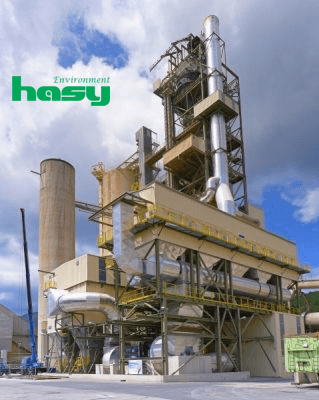
Factoryexhaust gas treatment system cement
Why choose?