Hasy Environment is a consulting unit, providing wastewater treatment systems with many years of experience in the field of treatment wastewater treatment
We are confident in meeting the strict requirements given by our customers. Aiming to jointly build and develop sustainable, environmentally friendly production
Vietnam has about 70 cassava starch processing factories with more than 4,000 small and medium-sized establishments. As the fastest growing industry, achieving high efficiency, thereby contributing greatly to the proportion of GDP in the country, in addition to the benefits it brings, wastewater from this industry is released into the environment in a not small amount, causing serious health problems. Serious environmental pollution if not treated.
What source does cassava starch wastewater come from?
Cassava starch wastewater is discharged from the process of washing cassava roots and sieving them; washing machinery and equipment, separating liquid, separating powder…
Domestic wastewater of factory employees.
How are the composition and properties of tapioca starch wastewater analyzed?
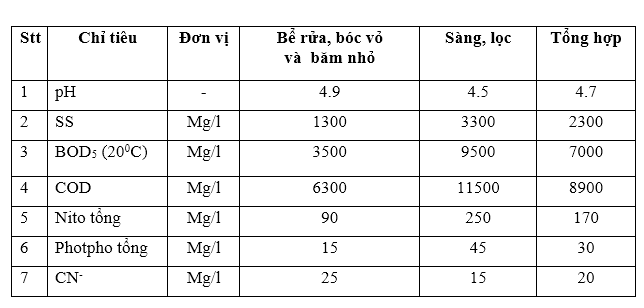
With an average output of 10-20 m3/ton of product, the amount of wastewater generated from the production process is not small and can be low pH fraction; High content of organic and inorganic substances, nutrients containing very high N, P, BOD, COD, containing Cyanide (CN–), one of the toxic substances that can cause cancer. letter.
Summary table of cassava starch pollution indicators
What technology effectively treats cassava starch wastewater
The technology to treat cassava starch wastewater is currently being selected and treated effectively by technologists to achieve the output standard of anaerobic combined aerobic biotechnology.
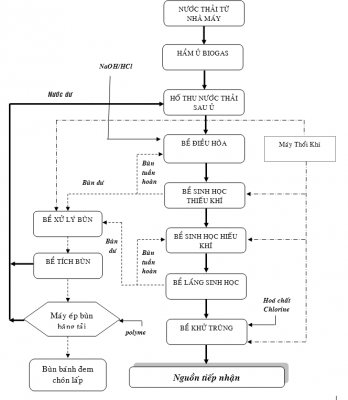
Technology diagram for wastewater treatment of cassava starch factory
Explanation of cassava starch wastewater treatment technology
At the collection tank
Wastewater from the factory area is separated from rainwater according to the centralized wastewater drainage system to the biogoas composting tank of the wastewater treatment station. Before wastewater enters the station, the wastewater pump passes through a raw trash separator to remove trash from the waste stream.
From the wastewater collection tank, the submersible pump pumps it to the equalization tank. Here the wastewater flow and components are regulated. The air conditioning tank has an air supply system. To avoid sedimentation and anaerobic decomposition, wastewater is pumped to an anaerobic biological tank.
At the anoxic tank
Suspended microorganisms are combined with a specialized PP substrate buffer to create an anaerobic microbial membrane, increasing the microbial density up to about 20,000 microorganisms/m3 wastewater, ensuring treatment efficiency according to COD and total P up to 75-80%.
Types of anaerobic microorganisms will help quickly decompose indigestible, difficult-to-decompose substances and residues such as: Cellulose, Starch, Chitin, Pectin, Protein, Lipids
At UASB tank
Wastewater is evenly distributed at the bottom of the tank and goes from bottom to top through the suspended sludge layer. When passing through this sludge layer, the anaerobic sludge mixture in the tank will adsorb organic matter in the wastewater, simultaneously When converted into biogas, the produced gas is carried up through the exhaust pipe and used as a gas energy source for the plant.
The treated water rises through the overflow trough and flows to the lamen deposit. After sedimentation, transfer to aerobic biological tank.
At the aerobic tank
The aerobic biological process takes place thanks to the amount of oxygen dissolved in the water, an appropriate amount of oxygen is provided to the activated sludge to compost the remaining organic matter in the wastewater. Most organic pollutants are used to maintain microbial life, so only a small amount of activated sludge is produced.
Then the water flows to the biological settling tank. Here the water is separated from the mud. The round water flows to the sterilization tank and the sludge settles and is pumped to the sludge tank
At the disinfection tank
The water in this tank is exposed to disinfectant chemicals before being discharged into the environment. After treating cassava starch production wastewater, it meets QCVN 63: 2017/ BTNMT. National technical regulations on cassava starch production wastewater.
The sludge in the sludge tank is pumped into a sludge press to form cakes and taken to the designated place. Residual water is circulated back to the equalization tank for the next processing step.
Advantages
Low investment costs thanks to available microorganisms
High ability to process organic compounds
Obtain gas for the production process
Why choose?
HASY environment
We offer free consultation and design selection costs to customers when constructing with HASY Environment
With many years of experience in the field of consulting, design and construction of exhaust gas treatment systems
With a team of professional consultants and designers, dedicated to customers



 Tiếng Việt