


 Tiếng Việt
Part of a series of articles on methods in exhaust gas treatment.
In this article we mention the electrostatic method of treating exhaust gases. It is also one of the effective methods of applying dust treatment worth considering.
The article will mention the content
Concept of electrostatic exhaust gas treatment
Electrostatic precipitator is a system that removes dust particles of microscopic size ( 0.01 − 10 µm). On the principle of ionizing and separating dust from the air when it passes through an area with a large electric field.
Electrostatic is considered a new technique in dust treatment that brings optimal efficiency.
Applying electrostatic mechanism to dust treatment systems is often used in industry or civil use.
Helps reduce aerodynamic resistance and increase filtration efficiency for industrial gas mixtures and combustion products, etc., which contain dust and potentially electrifying particles but have low consumption. low power.
Operating principles of the device exhaust gas treatment by electrostatic method
Electrostatic devices operate based on the following principle
- Uses electrical energy (DC), directly to filter dust.
- In an electrostatic precipitator, dust particles are deposited under the effect of electrostatic force.
Principle of operation
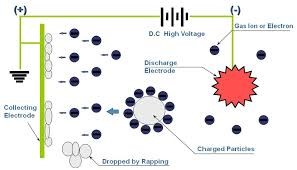
Image of operating principle diagram exhaust gas treatment by electrostatic method
The operating principle includes the following steps:
Step 1:
The discharge electrode is connected to the negative electrode with high voltage (can be up to 120kV). Creating a very strong electric field causes the discharge electrode to always be in discharge state.
The electrode plates will be arranged perpendicular to the direction of movement of the gas mixture.
The electrodes in the same row are staggered with each other in the direction of movement of the gas flow.
There is space between the plates in each row to allow the gas mixture to pass through easily. Helps dust particles containing a relatively small charge to reach the electrode plates by inertial force
Therefore, the device’s power consumption is significantly reduced (equivalent to only 10% of power consumption).
Step 2:
When the gas stream carrying dust enters the device, the dust particles (small sized dust particles. Neutral or non-neutral entering the negative magnetic field are immediately electrified.
Step 3:
Deposition electrodes are metal plates or tubes connected to a positive and grounded electrode.
It is a neutral electrode. It neutralizes the charge of electrified dust particles.
The electric electrode has a bar-shaped structure, with 2 grooves to drain dust (usually circular or triangular with the top curved to be close to the aerodynamic shape) at the edges on both sides.
This structure allows the placement of emitting electrodes in the gaps between the receiving electrodes and does not cause reverse discharge. Helps maximize electrical capacity while limiting aerodynamic resistance. The emitter electrode is the type commonly used in engineering.
Step 4:
When electrified dust particles come into contact with the deposition electrode, they immediately lose all charge and stick to the surface of the deposition electrode plate, creating large dust patches.
When the amount of dust on the settling pole is thick enough, it will be periodically removed using a percussion hammer system, tapping on the settling pole to create strong vibrations (using the wet, dust washing method), Let the dust fall into the dust deck.
Step 5:
After treatment, the gas will go out.

Image of electrostatic precipitator
Advantages and disadvantages of electrostatic devices
Advantages |
Disadvantages |
|
|
Application of exhaust gas treatment by electrostatic method
- Application of electrostatic mechanism to dust treatment system commonly used in industry or civil use . Helps reduce aerodynamic resistance or increase filtration capacity for industrial gas mixtures or combustion products… Which contain dust or some particles that are capable of electrification but have an absorbent level. low power consumption
- Commonly used in wood processing factories or sources
- Currently, environmental pollution is a problem for the entire society. Businesses and factories are directly discharging pollutants into the environment. It is necessary to apply measures to thoroughly treat pollutants from emission sources, especially dust. One of the effective methods of treating dust in exhaust gas is to apply electrostatic treatment.
Choose the exhaust gas treatment unit that is suitable for your company and meets the output criteria in waste discharge. Hasy Environment provides comprehensive solutions for exhaust gas treatment. Please call for a free consultation.
